On-Page SEO in Nepal at a glance
We often see Nepali sites with a homepage trying to rank for twenty different services at once, and service pages with two lines of text. Google can't tell which page should rank for what, so it ranks none of them well.
On-page SEO fixes that. We give each page one clear job, rewrite titles so people want to click, add the details that answer what searchers actually want to know, and connect pages with internal links so authority flows to the ones that matter.
Problems we fix
Duplicate titles
Every page called "Home | Company Name", so Google rewrites them and clicks drop.
Thin service pages
A heading and two sentences can't compete with a detailed competitor page.
Keyword cannibalisation
Three pages targeting the same keyword compete with each other.
What's included in our on-page SEO service
- Keyword-to-page mapping
- One primary keyword and related terms per page.
- Title and meta rewrite
- Under 60 and 155 characters, written to earn the click.
- Heading structure
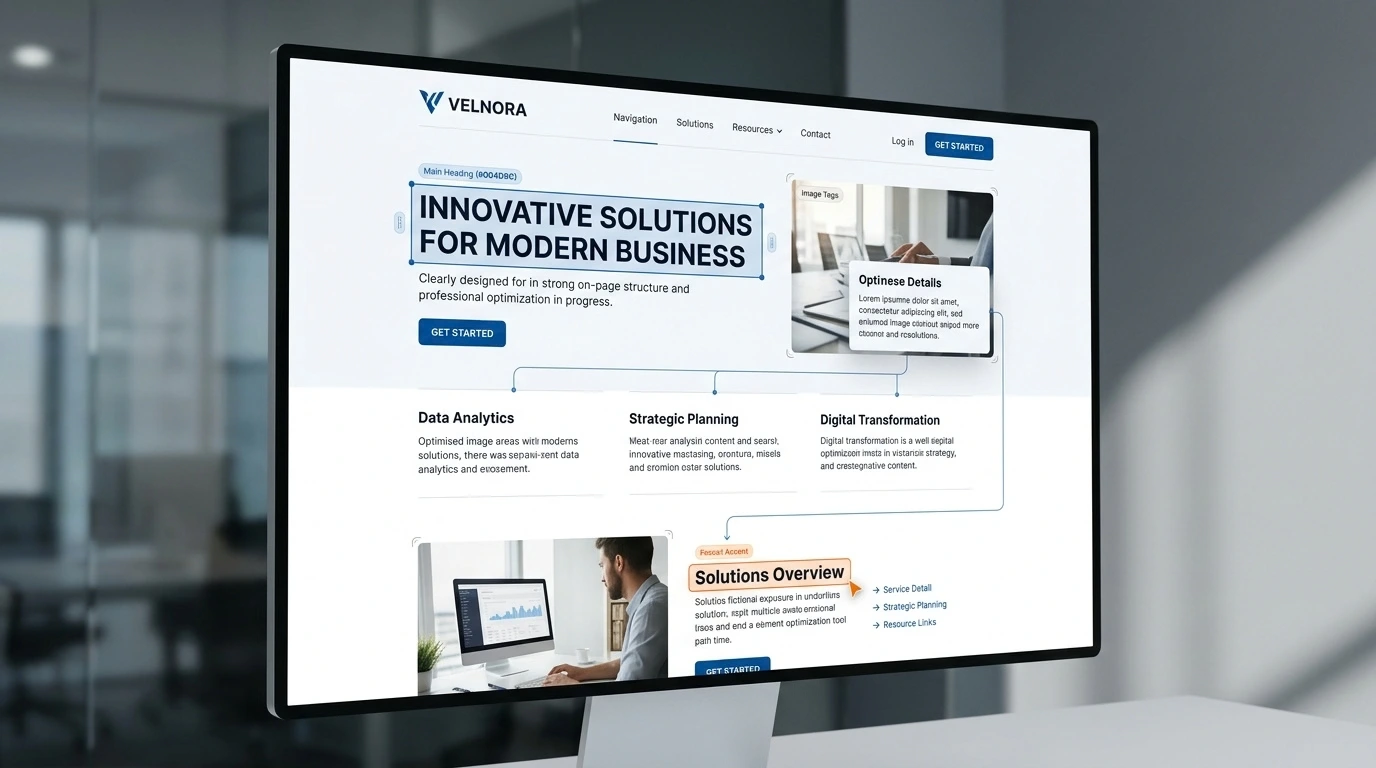
- One H1, logical H2/H3s that match search questions.
- Content improvement
- Add missing answers, examples, tables and FAQs.
- Internal linking
- Contextual links from strong pages to priority pages.
- Image SEO
- Compressed WebP images with descriptive alt text.
What are the most important on-page SEO factors?
The title tag, the main heading, whether the content fully answers the search, internal links pointing to the page, and how quickly the page loads on mobile. Meta descriptions don't affect rankings directly, but they decide whether people click.
Title tags carry the most weight for the least effort. Put the main keyword near the start, keep it under about 60 characters so it isn't cut off, and make it specific: 'Website Design in Kathmandu from NPR 30,000' beats 'Home | Our Company'.
Content depth is where most Nepali sites fall short. If the top results for a search explain prices, process and timelines, a page with three generic paragraphs can't compete, however well it's optimised.
What is keyword cannibalisation and how do you fix it?
Cannibalisation happens when several pages on your site target the same search, so Google can't decide which to rank and often ranks none of them well. The fix is to choose one page per keyword, merge or redirect the duplicates, and adjust internal links.
We find it by checking Search Console for queries where two or more of your URLs swap positions. It's common on sites with a blog post and a service page both titled 'SEO services in Nepal'. Usually the service page should win, and the blog post should be re-angled to a related question.
How do internal links help rankings?
Internal links tell Google which pages matter most and what they're about, and they pass authority from strong pages to newer ones. Descriptive anchor text, such as 'ecommerce website cost', helps more than 'click here'.
Your homepage and most-linked blog posts usually have the most authority. Linking from them to your priority service pages is one of the quickest on-page wins we know, and it costs nothing.
What's on a practical on-page SEO checklist?
One focus keyword per page, a title under about 60 characters with the keyword near the start, a meta description under about 155 characters, one H1, question-style H2s, a direct answer near the top, descriptive image alt text, internal links to and from related pages, and schema where it fits.
- Focus keyword mapped to one page
- Title ≤ 60 characters, keyword first
- Meta description ≤ 155 characters with a reason to click
- One H1, logical H2/H3s
- Answer in the first 60 words
- WebP images with alt text
- 3–5 internal links in context
- FAQ or Service schema
How do you choose which pages to optimise first?
Pages already ranking in positions 5–20 for valuable searches. They have proven relevance and only need a push, so changes there show results fastest.
Does changing a title tag really make a difference?
Often, yes. A clearer, more specific title can raise click-through rate from the same position, and a title that matches the search better can lift rankings.
By the numbers
How many characters Google shows
Approximate length before Google truncates on a desktop results page. Write titles and descriptions to fit, with the keyword near the start.
View the data
| Item | Value |
|---|---|
| Meta description | 155 chars |
| Title tag | 60 chars |
| URL slug (readable) | 50 chars |
On-page vs off-page vs technical SEO
Common mistakes we fix
| Mistake | What we do instead |
|---|---|
| The same title on every page | Unique titles with the main keyword first |
| Several pages for one keyword | One page per keyword, others redirected or re-angled |
| Images without alt text | Descriptive alt text on every image |
| No internal links to service pages | Contextual links from blogs and the homepage |
How we work
- 1Week 1
Crawl and map
List every page and its target keyword.
- 2Week 1
Prioritise
Start with pages closest to page one.
- 3Week 2–4
Optimise
Rewrite and restructure priority pages.
- 4Week 4+
Track
Watch impressions and positions in Search Console.
How much does on-page SEO cost in Nepal?
Quick audit
Sites under 50 pages
NPR 15,000 one-time
- Crawl + indexing check
- Core Web Vitals
- Top 20 fixes
- Video walkthrough
Full audit + fix
Business sites we can fix directly
NPR 35,000 one-time
- Everything in Quick audit
- We implement the fixes
- Schema markup
- Before/after report
Enterprise audit
Ecommerce and 500+ page sites
FromNPR 60,000 one-time
- Log-file analysis
- JavaScript rendering review
- Migration plan
- Dev-ready tickets
Prices in Nepali rupees, excluding 13% VAT. Ad spend paid to Meta, Google or TikTok is billed separately. Every quote is fixed in writing before work starts.
What changes the price
| Factor | How it affects your cost |
|---|---|
| Number of pages | A 10-page site is quicker than a 300-product store. |
| Content gaps | Pages that need new sections take writing time. |
| CMS access | Some platforms make edits slower than others. |
Tools we use
- Google SearchRankings, SERP features, AI Overviews
- Google Search ConsoleIndexing, queries, clicks
- Google Analytics 4Traffic, conversions, revenue
- AhrefsBacklinks, keyword difficulty
- SemrushKeyword research, competitor gaps
- Screaming FrogTechnical crawls, audits
- Google Tag ManagerEvent and conversion tracking
- Lighthouse / PageSpeedCore Web Vitals
- Looker StudioClient reporting dashboards
Want the full picture? See every technology and platform we work with.
Guides to read next
Get a free SEO audit first
On-Page SEO: frequently asked questions
What is on-page SEO?
Optimising the content and HTML of your own pages: titles, descriptions, headings, text, images, internal links and schema.
How long does on-page SEO take to work?
Changes are usually picked up within days, and ranking changes show within 4–10 weeks.
Is on-page SEO enough to rank?
For low-competition keywords, often yes. For competitive ones you'll also need links and technical SEO.
Do you change our website design?
Usually not. We work within your design, though sometimes we suggest layout changes to make pages clearer.
What's the ideal meta description length?
Around 140–155 characters, so it isn't cut off in results.
Do you need access to our website?
Editor access to your CMS, plus Google Search Console.